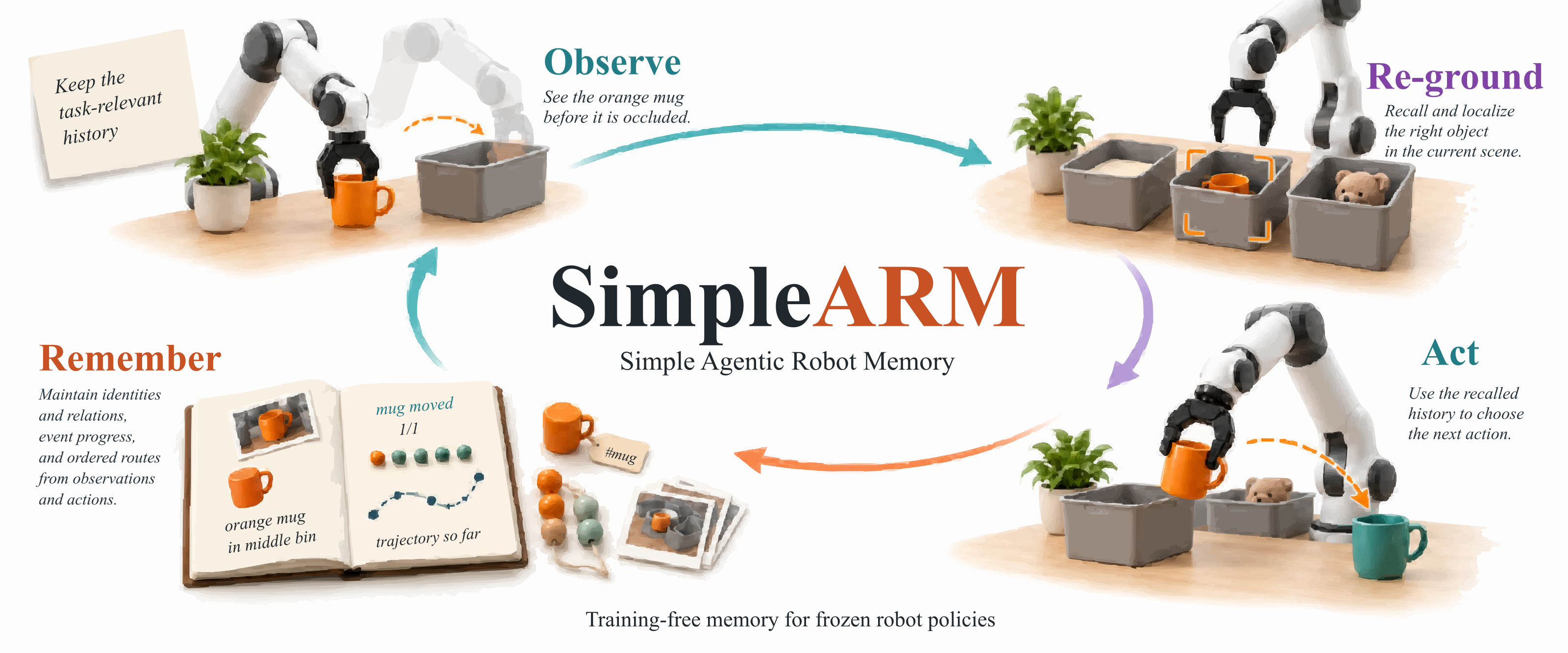
Remember the state that matters for the next action. Conceptual illustration
01 / The idea
Remember state. Not just frames.
A current image cannot tell a robot which object was hidden, how many actions it has completed, or which route it saw earlier. SimpleARM keeps this task-relevant history available for control.
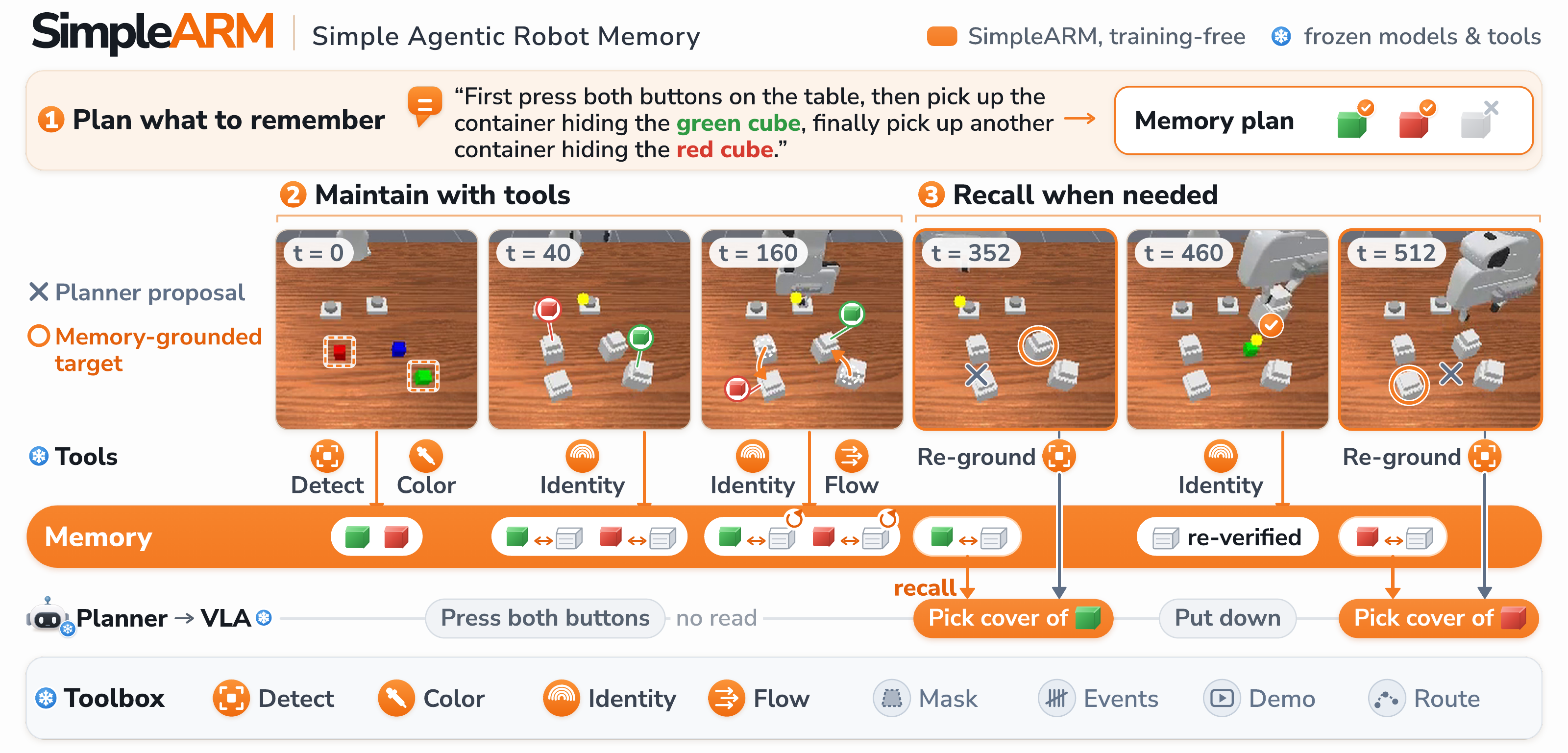
SimpleARM overview. Given the instruction, SimpleARM first specifies what historical state may be needed, then maintains that state online with frozen perception and event tools, and retrieves it only when the current subgoal depends on interaction history. Retrieved memory resolves historical identity, progress, or procedure; current perception provides any required spatial grounding, and the resulting memory-conditioned grounded subgoal is executed by the frozen VLA.
01
Decide what to remember
A vision–language model reads the instruction and proposes the identities, progress and procedures that may matter later.
Instruction → memory plan“Pick the container hiding the green cube.” Watch the cube–container relation.
02
Maintain it with tools
Frozen perception and event tools verify observations and update compact memory as the robot and its surroundings move.
DetectionIdentityOptical flowMasksEventsRoutes
03
Recall when needed
A history-dependent subgoal triggers the relevant read. Memory resolves the referent; current perception locates it for the frozen policy.
Memory → grounded action“The green cube is under this cover.” Pick that cover in the current view.
Three forms of task state
Entities & relationsWhich object? Under which cover?
Event progressHow many times? Which step next?
Ordered proceduresWhich route? In what order?
The added memory is episode-scoped and training-free. The pretrained grounded-subgoal composer, robot policy and perception models stay frozen.
02 / Memory in action
Out of sight. Still the right object.
Follow a real ButtonUnmaskSwap episode. The colors disappear and the covers move, but the memory keeps track of what is underneath.
“First press both buttons on the table, then pick up the container hiding the green cube, finally pick up another container hiding the red cube.”
t = 0
Memory-grounded target × Composer proposal
Observe
Notice what matters
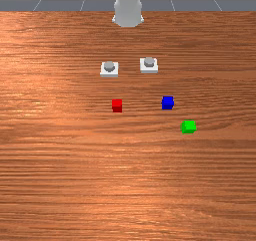
The green and red cubes are visible. The instruction selects these identities for memory.
Memory state / readoutGreen cube · red cube
Active operationDetection · color verification
01 / 07
About this example
Seed 7, episode 47, from a qualitative replication of the final configuration. The episode succeeds at step 596. These are recorded front-camera crops; the callouts and memory summaries explain the documented trace. A composer proposal is an intermediate target, not a separate no-memory rollout. Pixel verification, DINO identity features and optical flow were active here; SAM was unavailable on this rollout host.
03 / Across the benchmark
Small memory. A substantial difference.
Across all 16 RoboMME tasks, SimpleARM reaches 67.17% mean success. The largest gains appear when control needs persistent relations or references to the past.
Mean success over 3 seeds (%). Baselines are published results; SimpleARM values come from archived outcomes.
Suite
Task
No memory
MemER
FrameSamp
SimpleARM
System-level comparison with published baselines. Gains vary by task: Counting remains a limitation, including 0% on StopCube. The added memory receives no training; the pretrained policies use RoboMME’s existing checkpoints.
04 / What makes the difference?
Useful state needs the right access.
Remove a memory component or change how it is read, then compare with its matched full-method control. Every ablation covers all 800 episodes.
Matched full method vs. ablation
Full method Ablation · success (%)
Swipe to see the complete chart →
800 same-host, same-seed, same-task, same-episode pairs per row · seed 11. Each bead between endpoints = 1 pp of difference.
Maintain the history
Removing route memory lowers full-benchmark success by 11.50 pp; removing demonstration references lowers it by 9.13 pp.
Read it selectively
Replacing structured retrieval with a VLM decision at every proposed subgoal lowers success by 11.88 pp.
Keep the mixed results visible
Changing the source to received frames gives 0.00 pp aggregate change. The table does not show that every component helps every task.
All 10 ablations and exact matched effects +
Δ = ablation − matched full method, in percentage points. Each row has 800 pairs.
Intervention
Full (%)
Ablation (%)
Δ (pp)
The matched control varies by row because outcomes are matched to their actual execution host. These are single-seed interventions; component effects overlap and should not be added together.
05 / A closer look at visual history
What if we just keep the recent frames?
We also fine-tune and evaluate RoboMME’s FrameSamp + ModuL with the same Recent-N strategy at training and test time.
Recent32 has the highest observed mean of these three settings. This is a separate family of trained models from SimpleARM.
Matched Recent training & evaluation
Success (%) · one rung = 1 pp
Whiskers: ±1 sample SD across three evaluation seeds. One training seed (42) and one fixed final checkpoint per setting.
Evaluation details and Recent8
Recent4/16/32 each use evaluation seeds 7, 11 and 23, for 7,200 episodes in total. Some evaluation rounds ran on different hosts, so host effects are not isolated. Recent8 has one completed seed7 evaluation: 211/800 (26.375%). Its evaluated checkpoint used a 70k EMA warm start and reset optimizer; it is not included in the three-seed chart. Earlier inference-only Recent interventions on Uniform-trained weights are a separate experiment.
06 / Conclusion
Remember what matters. Bring it back to action.
SimpleARM turns interaction history into compact, task-relevant state. A memory plan decides what to retain, frozen tools maintain it as the world changes, and selective retrieval brings it back when a subgoal needs the past.
This simple, training-free memory layer helps frozen robot policies act on identities, progress and procedures that the current image alone cannot reveal.
Task-conditionedTool-maintainedRecalled on demand
Citation
If you find SimpleARM useful, please cite our paper.
@misc{zhang2026simpleagenticmemorygeneralist,
  title={Simple Agentic Memory for Generalist Robot Policies},
  author={Yuyou Zhang and Yunbei Zhang and Miao Li and Janet Wang and Zijian Jin and Shilong Liu and Ding Zhao},
  year={2026},
  eprint={2609.36595},
  archivePrefix={arXiv},
  primaryClass={cs.RO},
  url={https://arxiv.org/abs/2609.36595},
}